
Last updated September 10, 2026
Full 25-point door and opener safety check with every visit - springs, cables, rollers, tracks, and your LiftMaster or Chamberlain opener included
You get a price before we start. It does not change when the truck arrives.
 Before
 After
After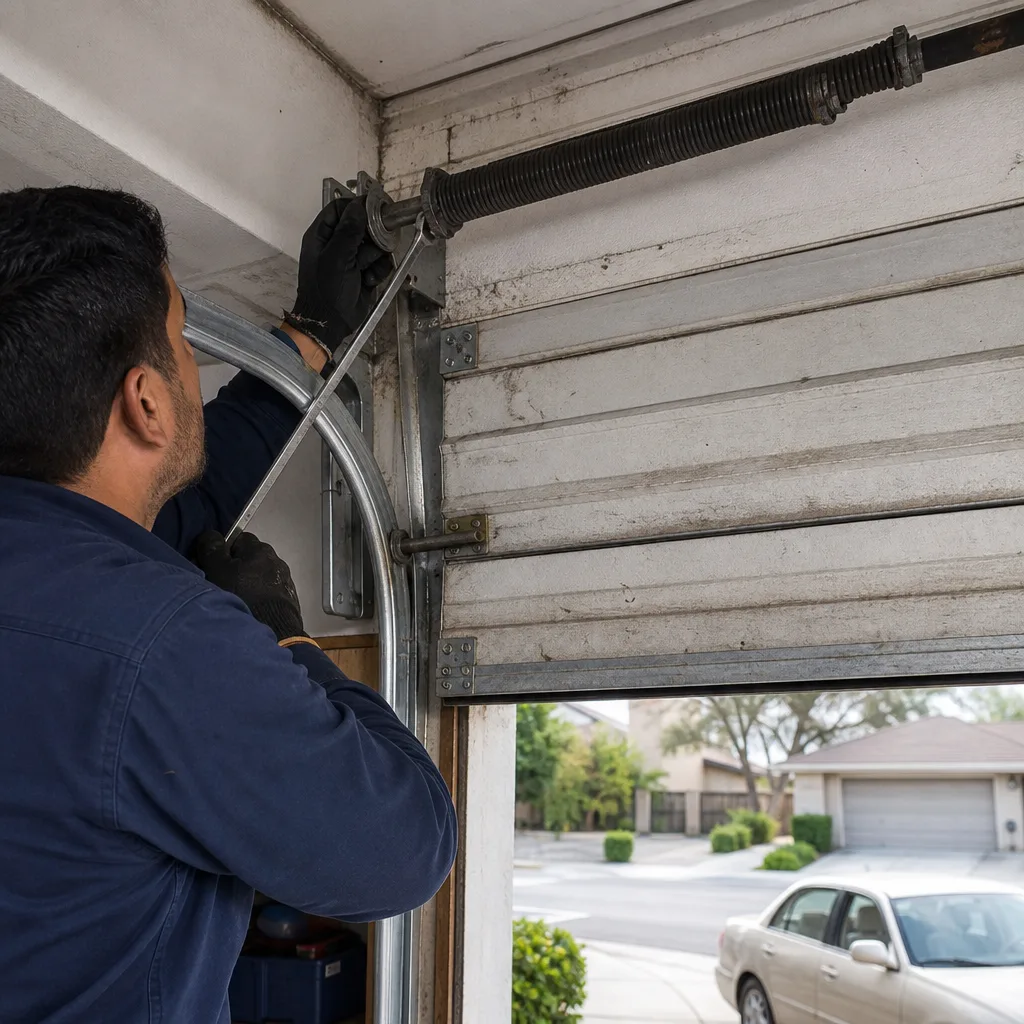 Before
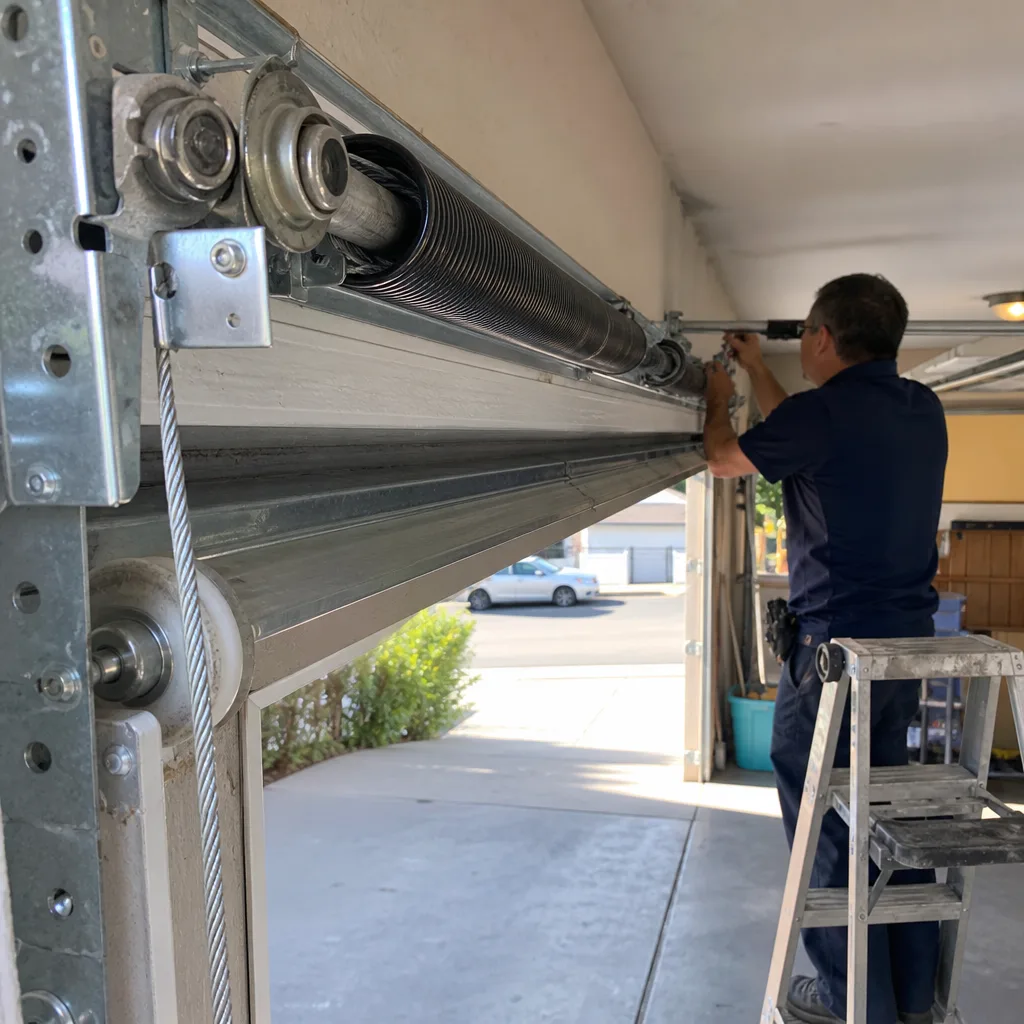 After
After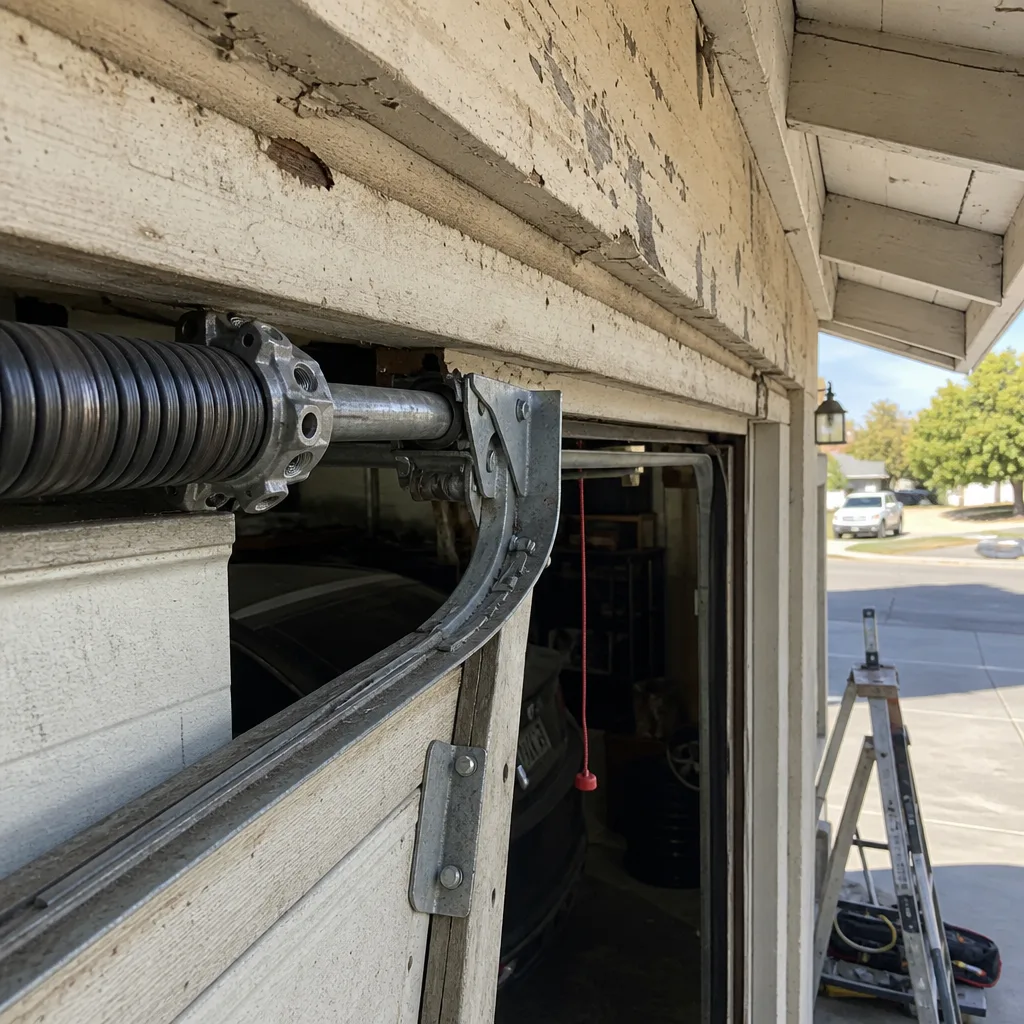 Before
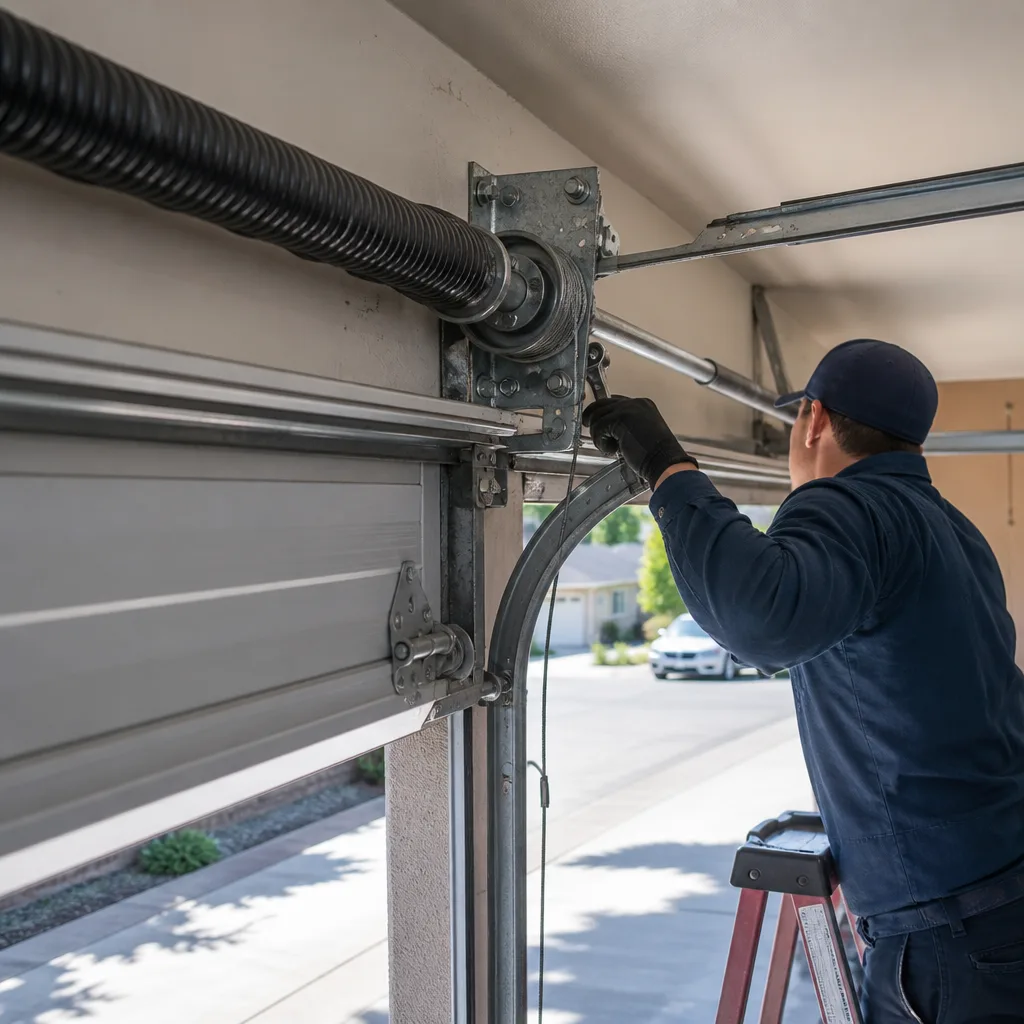 After
AfterDIY vs Professional Garage Door: The Santa Clarita Homeowner’s Decision Guide
Torsion springs store roughly 100 foot-pounds of torque per turn of winding. A standard residential spring is wound 30 turns at installation. A single slip of an unwinding bar can release that energy in under a second. This is not a cautionary exaggeration; it is mechanics. In Santa Clarita, we have seen competent homeowners, skilled carpenters among them, attempt spring replacement after watching a twenty-minute video. The result is predictable. This guide draws a precise line between what you can safely handle yourself and what requires a trained technician, so you stop paying for simple maintenance and never attempt the three tasks that send people to urgent care every year. For more on staying safe, see our Garage Door Repair Maintenance Checklist for Santa Clarita Homeowners.
Quick Answer
Most Santa Clarita homeowners can safely perform lubrication, sensor alignment, weatherstripping replacement, and keypad programming themselves. Torsion spring work, cable drum adjustment, and structural header repair should always be left to professionals due to serious injury risk. For everything in between, use the task classification below to decide based on specific hazards, not general handiness.
Table of Contents
- The Physics That Decides: Why Some Tasks Are Never DIY
- The Complete Task Classification Table: 20 Garage Door Jobs Ranked
- The Three Never-DIY Tasks: What Sends Homeowners to Urgent Care
- Safe DIY Maintenance You Should Own Yourself
- How Santa Clarita’s Heat Changes the DIY Equation
- Cost Savings Analysis: Real Numbers for Santa Clarita
- Documenting Your DIY Work: A Service History That Saves Money
- Tool Investments Worth Making (and Ones That Aren’t)
- Common Mistakes to Avoid
- When to Call a Professional
- Frequently Asked Questions
- The Bottom Line
The Physics That Decides: Why Some Tasks Are Never DIY
Garage doors are counterweighted systems. The springs, whether torsion or extension, bear the full weight of the door so a motor rated at half horsepower can lift hundreds of pounds. When that counterbalance fails, the door becomes a dead weight. More critically, the stored energy in a wound spring does not dissipate gradually. It releases instantaneously.
We have responded to calls in Valencia, Saugus, and Canyon Country where a homeowner’s winding bar slipped from a torsion cone. The bar struck a ceiling, a wall, or the homeowner. In one case on Seco Canyon Road, the bar broke the homeowner’s wrist and dented the hood of a car parked in the driveway. The spring itself is not the only hazard. A released cable whips unpredictably. A door dropping without spring support can crush fingers, feet, or a pet.
The dividing line is not about whether you are handy. It is about whether a mistake causes structural damage or bodily injury before you can react. Tasks involving stored mechanical energy, overhead dead weight, or structural load-bearing members fall on the professional side of that line. Period.
This is why garage door repair in Santa Clarita requires different skills than other home maintenance. The forces involved are not comparable to fixing a leaky faucet or replacing a light switch.
The Complete Task Classification Table: 20 Garage Door Jobs Ranked
We classify every garage door task into three categories based on what happens when something goes wrong. Use this table as your decision tool.
Safe DIY - Low Consequence of Error
These tasks involve no stored energy, no overhead weight, and no structural loads. Mistakes are reversible and rarely cause injury.
| Task | Why It’s Safe | Typical Time |
|---|---|---|
| Lubricating rollers, hinges, and tracks | No disassembly required; no tensioned parts | 20-30 minutes |
| Replacing weatherstripping / bottom seal | Door is closed and secured; no spring contact | 30-45 minutes |
| Aligning safety sensors | Low voltage; no mechanical load | 10-15 minutes |
| Programming remotes and keypads | Electronic only; no physical door interaction | 5-10 minutes |
| Cleaning photo-eye lenses | No tools required; no force applied | 5 minutes |
| Tightening loose track brackets (if door is secured open) | Brackets are not load-bearing; door is blocked | 15-20 minutes |
| Replacing remote batteries | Self-explanatory | 2 minutes |
DIY With Caution - Moderate Consequence of Error
These tasks can be done by a careful homeowner but require specific preparation: securing the door, using proper tools, and stopping if anything feels wrong.
| Task | Hazard | Required Precaution |
|---|---|---|
| Replacing rollers (non-bottom) | Door could shift if unsecured | Clamp door to track; use locking pliers |
| Adjusting travel limits on opener | Door could over-travel and strain components | Test incrementally; stay clear of door path |
| Replacing a damaged panel (non-structural) | Door is heavy; panel alignment affects operation | Have a second person; support door fully |
| Installing a new opener (same type, replacement) | Electrical work; overhead mounting | Turn off breaker; use proper ladder safety |
| Replacing weatherstripping on a wood door | Door material is softer; fasteners strip easily | Pre-drill; use exterior-grade fasteners only |
| Adjusting force settings on opener | Excessive force overrides safety reverse | Test with 2×4 block per manufacturer spec |
Professional Only - Serious Injury or Structural Risk
These tasks involve stored energy, overhead dead weight, or structural integrity. The consequence of error is severe and immediate.
| Task | Specific Hazard | Why Training Matters |
|---|---|---|
| Torsion spring replacement or winding | 1,000+ ft-lbs stored energy; winding bar can strike with lethal force | Proper winding technique, bar sizing, and cone engagement require hands-on training |
| Cable drum adjustment or replacement | Cable under tension can whip; improper drum spacing causes door to drop unevenly | Drum position affects cable wrap geometry; errors cause immediate failure |
| Structural header repair or replacement | Header carries entire door load and often roof/second-floor load above | Load calculations, permit requirements, and temporary support are code-specific |
| Extension spring replacement (with safety cables) | Springs can detach and fly; safety cable installation is itself technical | Proper safety cable routing and spring hook engagement prevent projectile failure |
| Track replacement or major realignment | Door can fall from track; track geometry affects spring loading | Vertical-to-horizontal transition angles are precision-critical |
| Bottom bracket replacement | Bottom brackets connect directly to torsion cable; under full spring tension | Specialized tools required to release and re-tension safely |
| Installing a new door (complete system) | Multiple hazards combined; door is largest moving object in most homes | Spring selection, track geometry, and opener sizing are interdependent calculations |
For garage door installation in Santa Clarita, the interdependence of spring rate, track radius, and opener horsepower means errors in any one element stress the others. We have seen DIY installations where an undersized opener burned out within a year because the spring balance was off by 5 percent.
The Three Never-DIY Tasks: What Sends Homeowners to Urgent Care
Every year, emergency rooms in the Santa Clarita Valley treat garage door-related injuries that were preventable. The three tasks below account for the majority of serious cases we hear about from local physicians and, in one case, a firefighter in Newhall who responded to a call where a homeowner was pinned.
1. Torsion Spring Work
The statistics are straightforward. A standard 2-car garage door weighs 150-250 pounds. The torsion spring is sized so that, when properly wound, the door is nearly weightless to the opener. That means the spring stores the full potential energy of the door at its highest point. Winding a spring requires inserting solid steel bars into the winding cone and adding tension, typically 7.5-8.5 turns for a standard 7-foot door, 9-10 turns for 8-foot.
If the bar is not fully seated, if the set screws are not properly tightened, if the cone is cracked or the wrong bar diameter is used, the bar becomes a projectile. We have seen bars penetrate drywall. We have seen them break collarbones. The hazard is not theoretical.
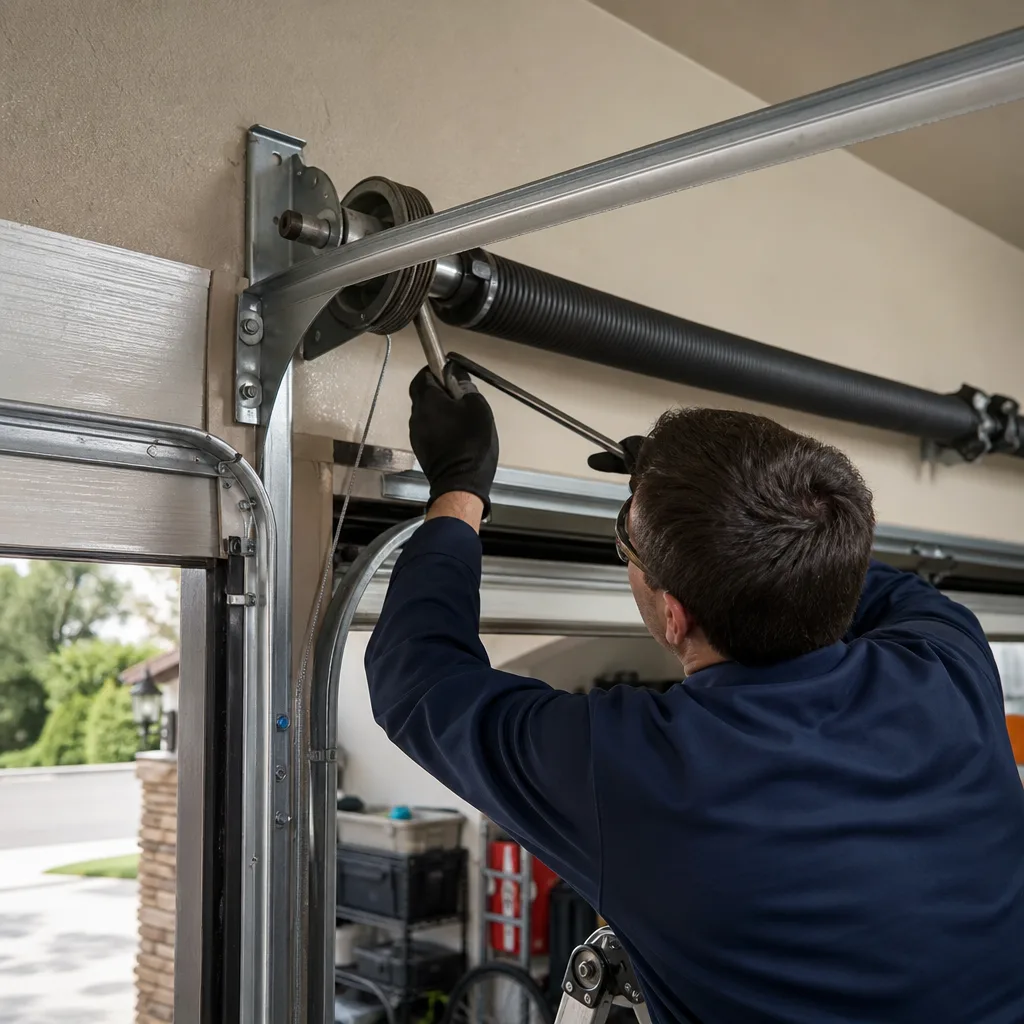
Professional technicians use specific bar diameters matched to the cone, check cone integrity before winding, and stand positioned so that a slip directs energy away from the body. These are not precautions you can learn from a video. They are physical habits developed through repeated supervised practice.
2. Cable Drum Adjustment
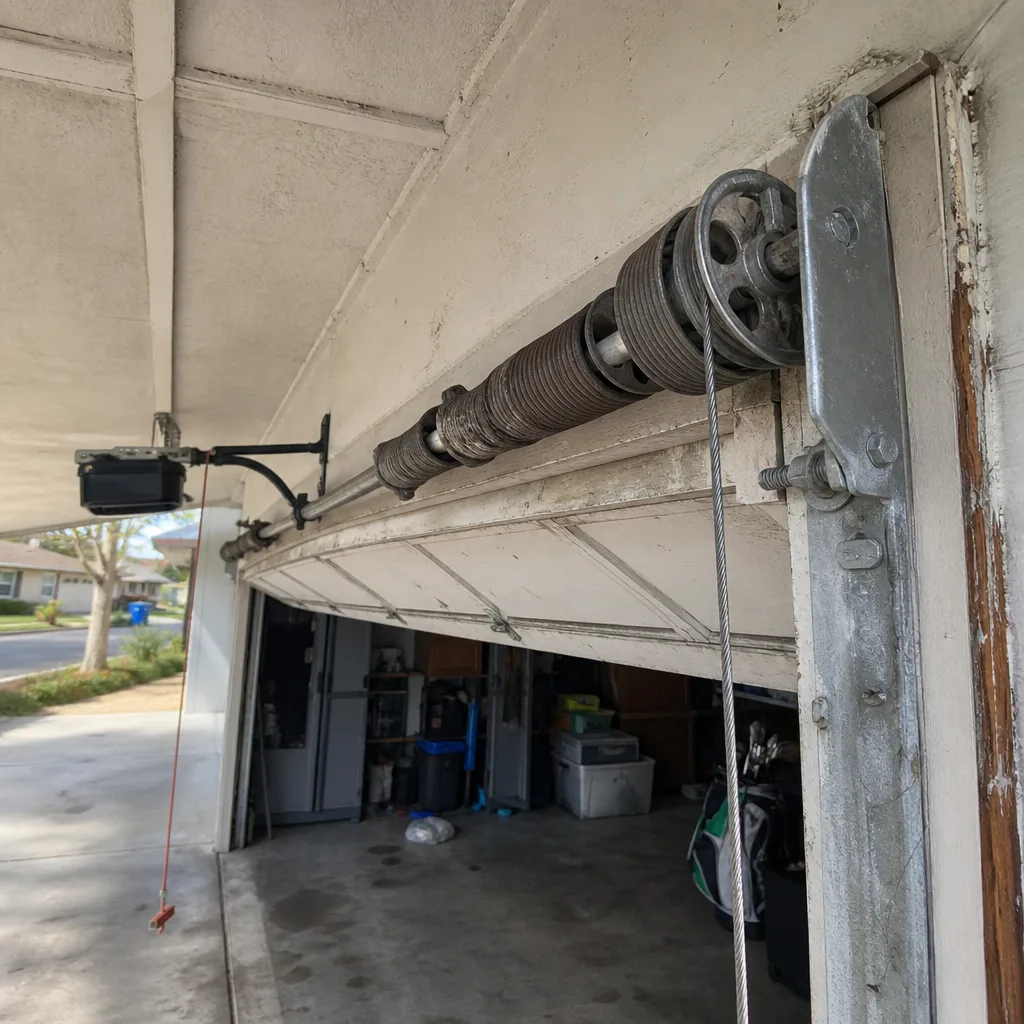
Cable drums sit at the ends of the torsion tube and govern how cable wraps as the door opens and closes. The drum position determines whether the door lifts level and whether the cable stacks properly. A drum set too far inward causes the cable to overlap and fray. A drum set too far outward causes the cable to slip off.
Adjusting a drum requires releasing torsion tension first, which brings you back to task #1. Even with tension released, the cable itself is under residual load from the door weight. A slip during adjustment can cause the door to drop several feet before you react. We replaced a door in Sand Canyon last year where a homeowner’s drum adjustment attempt caused the door to fall onto a workbench, creasing two panels and bending the track.
3. Structural Header Repair
The header above your garage door is not merely decorative trim. It is a structural member that carries the door’s weight during operation and, in many Santa Clarita homes built before 1995, carries roof or second-floor loads as well. Headers in older Valencia and Saugus tract homes are often 4×6 or 4×8 solid lumber, sometimes with visible sag after thirty years of load.
Replacing or reinforcing a header requires temporary support of the load above, proper sizing per current building code (the 2022 California Residential Code applies in Santa Clarita), and often a permit. See Garage Door Permits, Codes & Inspections in CA: What You Need to Know for details. The Santa Clarita Building and Safety Division requires permits for structural modifications. A failed header does not give warning. It collapses. The door, the track, and everything above it comes down together.
Safe DIY Maintenance You Should Own Yourself
Homeowners who handle basic maintenance extend door life significantly and reduce service calls. These four tasks are worth your time.
1. Lubrication (Every 6 Months)
Use a silicone-based spray or white lithium grease on rollers, hinges, and the top of the rail where the trolley travels. Do not lubricate the track itself; the rollers need friction to roll rather than slide. In Santa Clarita’s dry climate, dust mixes with old lubricant and forms a grinding paste. We see this particularly in homes near the hills in Stevenson Ranch and Sand Canyon, where Santa Ana winds carry fine particulate.
- Close the door and disconnect the opener (pull the red release cord).
- Wipe old grease from hinges and roller stems with a rag.
- Apply light coating to each hinge pivot point and roller stem.
- Lubricate the bearing plates at each end of the torsion tube (the circular plates on the wall; do not touch the spring itself).
- Run the door manually several times to distribute.
- Reconnect opener.
Time: 25 minutes. Cost: $8-$12 for proper lubricant. Professional charge for same service: $89-$129 as part of a tune-up.
2. Weatherstripping Replacement (Every 3-5 Years)
The bottom seal and side weatherstripping harden and crack in Santa Clarita’s heat. A compromised seal lets dust, rodents, and conditioned air escape. Measure your door width, order the correct profile (T-end, bead-end, or bulb style), and slide or nail in replacement.
Key detail: in July and August, the old vinyl can be brittle and the new seal can soften during installation. Work in morning hours, or the seal may deform as you install it.
3. Sensor Alignment
When the door reverses for no apparent reason, dirty or misaligned photo eyes are the cause in roughly 60 percent of cases we diagnose. The LED indicators on LiftMaster, Chamberlain, and Genie units tell you the status: steady usually means aligned, blinking means blocked or misaligned.
- Clean both lenses with a soft cloth.
- Verify both LEDs show normal status.
- If one blinks, loosen its wing nut, adjust until both LEDs steady, then retighten.
- Test by closing door; wave an object through the beam; door should reverse.
4. Keypad and Remote Programming
Manufacturers change programming sequences every few years. For current LiftMaster and Chamberlain models, press the Learn button on the opener, enter your PIN on the keypad within 30 seconds, and hold Enter. For Genie Intellicode units, the sequence differs. Consult your specific model manual; the PDF is usually findable by model number. If you have an older unit and the manual is lost, we keep programming guides for all major brands on our service trucks.
How Santa Clarita’s Heat Changes the DIY Equation
Santa Clarita’s climate is not incidental to garage door work. It is a material factor.
Summer temperatures regularly exceed 95°F, and garage interiors reach 110°F or higher. This affects DIY work in specific ways:
- Metal expansion: Steel tracks and springs expand measurably in heat. A track alignment that reads correct at 8 AM may bind at 3 PM. We schedule precision adjustments for morning hours, and we recommend homeowners do the same for any task involving track or roller contact.
- Vinyl and rubber degradation: Bottom seals and weatherstripping become pliable and difficult to seat properly in midday heat. The material can stretch during installation, then contract and leave gaps once cooled. In Canyon Country and Saugus, where afternoon garage temperatures peak, we have replaced seals that were installed at 2 PM and leaked by evening.
- Opener thermal protection: Modern openers have thermal cutoffs. In a hot garage, repeated operation during testing can trigger shutdown. If you are adjusting travel limits or force settings, the opener may stop responding and appear faulty when it is simply protecting its motor. Wait 15 minutes and test again.
- Personal safety: Heat exhaustion is real. A task that takes 30 minutes at 75°F takes longer when you are dehydrated and your grip is compromised. The tasks we classify as “DIY With Caution” become more dangerous when you are not at full capacity.
We recommend scheduling any garage work before 10 AM from June through September. This is not preference. It is physics and physiology.
Cost Savings Analysis: Real Numbers for Santa Clarita
Homeowners often ask whether DIY maintenance is worth the time. Here are actual cost comparisons based on Santa Clarita market rates in 2024-2025.
| Task | DIY Cost | Professional Cost (Santa Clarita) | Annual Savings (DIY) |
|---|---|---|---|
| Bi-annual lubrication | $8-$12 (lubricant) | $89-$129 (tune-up component) | $160-$240 |
| Weatherstripping replacement | $25-$45 (material) | $150-$220 (installed) | $125-$175 (every 3-5 years) |
| Sensor alignment | $0 | $89-$129 (service call minimum) | $89-$129 (per incident) |
| Remote/keypad programming | $0 | $89-$129 (service call minimum) | $89-$129 (per incident) |
| Roller replacement (4 rollers, non-bottom) | $30-$60 (parts) | $180-$280 (parts + labor) | $120-$220 (per occurrence) |
Over five years, a homeowner who handles these five tasks themselves saves approximately $800-$1,400. That is real money. It is also money you should not attempt to save on the three Professional Only tasks, where a single error costs exponentially more in medical bills, door replacement, or structural repair.
Our garage door opener in Santa Clarita service includes programming assistance at no additional charge when we are on-site for other work. We do not believe in charging for five minutes of button-pressing.
Documenting Your DIY Work: A Service History That Saves Money
When you do perform maintenance yourself, document it. A clear record prevents redundant diagnostic charges and helps any technician who works on your door later.
Keep a simple log:
- Date and task performed (e.g., “March 15, 2025 - lubricated hinges, rollers, bearing plates; replaced bottom seal”)
- Products used (brand and type of lubricant, seal part number if known)
- Observations (e.g., “right side cable shows slight fraying at drum - monitor”; “opener strained slightly at top of travel”)
- Photos of any wear, damage, or concerning conditions
When you call for professional service, email or text this log ahead of time. A technician who knows you lubricated last month does not need to charge for diagnostic time determining whether the noise is lack of lubrication or a failing bearing. In our experience, documented maintenance histories save 15-20 minutes of diagnostic time per visit. At standard rates, that is $35-$50 saved per call.
We have customers in Valencia and Newhall who keep a folder on their phone with dated photos. When they call Mainspring Garage Door Co. home, they send the folder. We arrive knowing what we are looking at. That is a square deal on both sides.
Tool Investments Worth Making (and Ones That Aren’t)
Some DIY tasks require specific tools. Others do not justify the purchase.
Worth Owning
- Good silicone spray or white lithium grease: $8-$12. Use twice yearly.
- Adjustable wrench set, 8″ and 10″: $25-$40. Track bracket work, general hardware.
- Level (24″): $15-$25. Verifying track plumb during minor adjustments.
- Step ladder, 6-foot, rated for your weight plus tools: $60-$90. Do not use chairs or unstable surfaces.
- Locking pliers (2 pair): $20-$30. Securing door to track during roller replacement.
Not Worth Owning for Occasional Use
- Torsion winding bars: $40-$60, but using them without training is the hazard. Do not buy these as a “just in case.”
- Cable pullers and come-alongs: $80-$150. Required for cable work, but the work itself is Professional Only.
- Spring winding cones: $15-$30. These are consumable parts for professionals, not homeowner tools.
The $150 total for worthwhile tools pays for itself in the first year of DIY maintenance. Spend it once, maintain the tools, and you are equipped for a decade.
Common Mistakes to Avoid
- Using WD-40 as garage door lubricant. WD-40 is a solvent and light penetrant, not a lubricant. It displaces moisture temporarily, then evaporates and leaves metal dry. In Santa Clarita’s dusty environment, it actually attracts grit. Use silicone spray or white lithium grease instead.
- Adjusting track with the door unsecured. A door in the open position can roll or fall if the track is loosened. Always clamp the door to the track with locking pliers, or better, close the door and work on vertical track sections with the door resting on the floor.
- Ignoring the morning heat rule in July and August. We have replaced seals that were stretched during 2 PM installation and leaked by evening. Work before 10 AM when possible, or wait for a cooler day.
- Assuming all openers program the same way. A LiftMaster MyQ system, a Chamberlain B970, and a Genie ChainLift have different button sequences. Forcing the wrong sequence can lock the opener into a diagnostic mode that requires a factory reset.
- Not testing the safety reverse after any adjustment. Federal law (UL 325) requires automatic reversal. After adjusting travel limits, force settings, or sensors, test with a 2×4 laid flat in the door path. The door must reverse on contact. If it does not, stop using the door and call a professional.
- Attempting “just a little” spring tension release. There is no safe partial release. Torsion springs are fully tensioned or properly unwound with bars in place. Any intermediate state is unstable.
- Hiring unlicensed help for the Professional Only tasks. A handyman with a ladder is not a garage door technician. In Santa Clarita, garage door contractors must hold a C-61/D-49 license (Garage Door and Automatic Gate). Verify at cslb.ca.gov. Unlicensed work voids manufacturer warranties and leaves you without recourse if injury or damage occurs.
When to Call a Professional
Call when the task involves stored energy, overhead dead weight, or structural members. Call when the door is off its track, a spring is broken, a cable is frayed or detached, or the opener strains and reverses without clear cause. Call when you have attempted the Safe DIY steps and the problem persists; persistence often indicates a deeper issue.
In Santa Clarita, Mainspring Garage Door Co. offers free estimates. Browse our more guides & resources for additional homeowner help. We answer the phone with a live person, 24/7, including nights, weekends, and holidays. Our trucks carry springs, cables, openers, and hardware for all major brands, so most jobs finish in a single visit. The flat price is stated before any work begins. If the work is not done right, we come back at no charge. That promise is in writing on every job.
Call (661) 384-8741 for a free estimate.
Frequently Asked Questions
Most common repairs in Santa Clarita range from $180 for a simple roller or hinge replacement to $340 for spring work on a standard two-car door. Opener repairs typically fall between $150 and $280 depending on whether the issue is electrical or mechanical. We state the flat price before any work begins, so there are no surprises on the bill. Call (661) 384-8741 for an exact quote; estimates are free.
No. Torsion spring replacement requires specialized training and tools, and a single slip can cause serious injury. Even extension springs, which appear simpler, store dangerous energy and require proper safety cable installation. This is one of the three tasks we classify as Professional Only regardless of homeowner skill. The cost of professional spring replacement in Santa Clarita, typically $280-$340, includes the warranty and the certainty that it is done right.
Every six months. The dry, dusty conditions in Santa Clarita, particularly in hillside neighborhoods like Sand Canyon and Stevenson Ranch, cause lubricant to degrade faster than in coastal climates. We recommend April and October as ideal timing, before summer heat peaks and before winter rains (when they occur) wash residue into the track. Use silicone spray or white lithium grease; never WD-40.
No. At Mainspring Garage Door Co., the price we quote is the price you pay. We diagnose over the phone when possible, confirm on arrival, and state the flat price before any work begins. If we discover additional issues during service, we stop and explain before proceeding. There are no surprises on the bill. This is part of our 90-Day Done Right Promise, in writing on every job.
Yes. Our technicians arrive with springs, cables, rollers, hinges, openers, and hardware for all major brands including LiftMaster, Chamberlain, Genie, and Clopay. Most repairs are completed in a single visit. If you have an unusual door or discontinued model, we will tell you honestly if a part needs ordering rather than leaving you waiting unnecessarily.
Yes, every two to three years. Professional tune-ups include balance testing, spring tension verification, cable and drum inspection, opener force setting verification, and safety reverse testing with calibrated equipment. These are diagnostic procedures, not maintenance tasks. Our $89 Seasonal Tune-Up identifies wear before failure. In Santa Clarita’s heat, catching a weakening spring or fraying cable early prevents the emergency call at 10 PM.
The Bottom Line
The DIY-versus-professional question is not about whether you are capable. It is about which tasks carry consequences you cannot undo. Lubricate your door. Replace the weatherstripping. Align the sensors. Program the remotes. These save money and build familiarity with your system. Never touch a torsion spring, a cable drum, or a structural header. The injury risk is real, immediate, and disproportionate to any savings. In Santa Clarita’s heat, time your work for morning hours and document what you do. When a task crosses the line into stored energy or structural load, call a licensed professional who states the price upfront, carries the parts, and stands behind the work in writing. That is a square deal. That is how you never have to think about your garage door again.
Written by Carl Dutton, Owner at Mainspring Garage Door Co., serving Santa Clarita since 2016.